Location: Mira el Río Baja, Madrid Typology: Residential, tourist accommodation Client: Private Date:2017 Photography: Alberto AmoresThe renovation is inspired by an ancient legend that tells how, during the flooding of the Manzanares River, the streets Mira el Río Baja, Mira el Río Alta, and Mira el Sol became natural viewpoints from which residents could observe the overflowing waters. This story was immortalized in the tiles painted by Alfredo Ruiz de Luna in the 1990s for the streets of Madrid’s historic center, and today it serves as a starting point to rethink the relationship between city, river, and shelter.
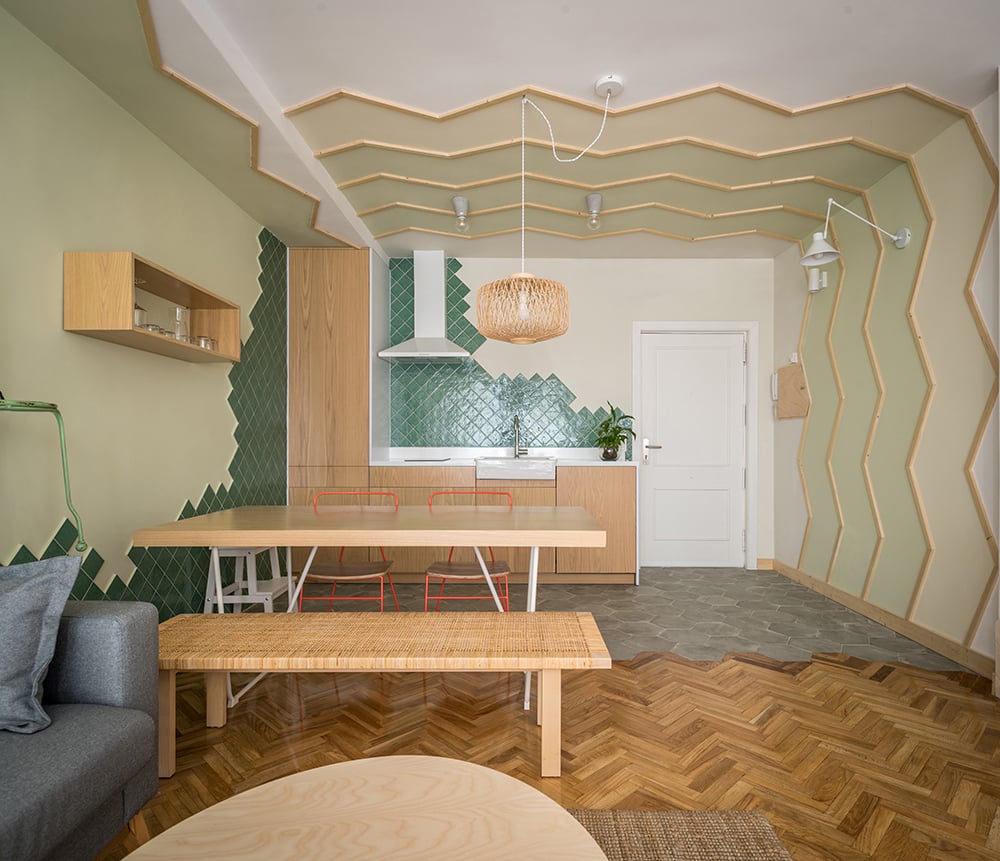
Looking at the river is also a way of observing the city and its shadows, of discovering the places where, in a more rural Madrid than we can now imagine, people found refuge during countryside outings. That idea of shelter , of protection under the shade, directly inspires this renovation on Calle Mira el Río Baja. Elements that once provided protection , tree branches , are here transformed into architectural structures that define the domestic space. Beneath these wooden “branches,” the kitchen, bathroom, and bedroom are grouped, creating a metaphor in which each room becomes a small refuge. The living room, as the public heart of the home, opens toward the banks of this imagined river, while the wooden slats evoke tree trunks and branches, and the geometric tiles allude to the flow of water and the rocks along the riverbed.
The spatial organization draws inspiration from how we inhabit nature, as if a day in the countryside had been transformed into a home. The kitchen sits in the shade but close to the river; the living room, bathed in sunlight, also faces the water; the bedroom retreats to a cooler, quieter area; the bathroom occupies an intermediate position, near the refreshing shade; and the desk, nestled among the “rocks,” becomes a corner for reflection between light and shadow.
The geometry is used to soften boundaries, making forms appear more organic, as if shaped by the landscape itself. Material choices reinforce this natural connection: wood brings warmth and intimacy, while the tiling introduces a sense of freshness that balances the composition. Colors extend this reading: blue represents water and damp areas; green climbs the walls like spontaneous vegetation growing by the fountains; cream tones evoke rocks where one can sit and rest; and gray and earthy hues recall the foliage under which shelter is sought.
In this way, the home is conceived as an exercise in landscape reinterpretation, an attempt to recover the experience of feeling comfortable, protected, and cool amidst the urban heat. In one of Madrid’s oldest neighborhoods, this renovation proposes a dialogue between nature and the city, between memory and contemporary life, mindful of rising temperatures and the urban heat island effect that characterizes the capital during today’s summers.
The renovation is inspired by an ancient legend that tells how, during the flooding of the Manzanares River, the streets Mira el Río Baja, Mira el Río Alta, and Mira el Sol became natural viewpoints from which residents could observe the overflowing waters. This story was immortalized in the tiles painted by Alfredo Ruiz de Luna in the 1990s for the streets of Madrid’s historic center, and today it serves as a starting point to rethink the relationship between city, river, and shelter.
Looking at the river is also a way of observing the city and its shadows, of discovering the places where, in a more rural Madrid than we can now imagine, people found refuge during countryside outings. That idea of shelter , of protection under the shade , directly inspires this renovation on Calle Mira el Río Baja. Elements that once provided protection, tree branches, are here transformed into architectural structures that define the domestic space. Beneath these wooden “branches,” the kitchen, bathroom, and bedroom are grouped, creating a metaphor in which each room becomes a small refuge. The living room, as the public heart of the home, opens toward the banks of this imagined river, while the wooden slats evoke tree trunks and branches, and the geometric tiles allude to the flow of water and the rocks along the riverbed.
The spatial organization draws inspiration from how we inhabit nature, as if a day in the countryside had been transformed into a home. The kitchen sits in the shade but close to the river; the living room, bathed in sunlight, also faces the water; the bedroom retreats to a cooler, quieter area; the bathroom occupies an intermediate position, near the refreshing shade; and the desk, nestled among the “rocks,” becomes a corner for reflection between light and shadow.
The geometry is used to soften boundaries, making forms appear more organic, as if shaped by the landscape itself. Material choices reinforce this natural connection: wood brings warmth and intimacy, while the tiling introduces a sense of freshness that balances the composition. Colors extend this reading: blue represents water and damp areas; green climbs the walls like spontaneous vegetation growing by the fountains; cream tones evoke rocks where one can sit and rest; and gray and earthy hues recall the foliage under which shelter is sought.
In this way, the home is conceived as an exercise in landscape reinterpretation, an attempt to recover the experience of feeling comfortable, protected, and cool amidst the urban heat. In one of Madrid’s oldest neighborhoods, this renovation proposes a dialogue between nature and the city, between memory and contemporary life, mindful of rising temperatures and the urban heat island effect that characterizes the capital during today’s summers.
Location: Mira el Río Baja, Madrid Typology: Residential, tourist accommodation Client: Private Date: 2017 Photography: Alberto Amores