Location: Ribera de Curtidores, Madrid Typology: Residential Client: Private Date: 2020-21 Photography: Alberto Amores Press: AD España; TeleMadrid; Diario DesignThe renovation is located on Ribera de Curtidores Street, home every Sunday to one of the city’s most traditional plans: El Rastro flea market. History tells that the market takes its name from the traces once left by animal hides used by the tanners (curtidores) who were established along this street. The building is a historic construction from 1880, characterized by its three storeys plus attic, with the first floor higher than the rest. Built with load-bearing walls running parallel to both the main and rear façades, the renovation takes advantage of the three bays generated between them. These three bays are used to define the three key moments of domestic life. Opening up these spaces and carefully shaping their layout is where the project demands the greatest attention from the very beginning.
Eat, emjoy, love.
Eat: This is the central axis of the home, through which everyday life in the other two spaces subtly filters. A beer or a glass of wine can easily turn into a traditional cocido. Organized symmetrically around the island, the design deliberately avoids increasing the height of the cabinetry in order to preserve the presence of the original exposed brick party wall during meals. On the opposite side, a long white table helps bring light into the darkest area of the space..
Enjoy: Life is meant to be enjoyed whether doing nothing on the sofa, working on what you are passionate about, or becoming the quintessential Rastro onlooker on Sunday mornings. The three balconies facing the living room are left completely open, without partitions, preserving original moldings, ceiling rosettes and radiators.
Love: The first thing in life , and upon arriving home , is to take care of oneself and to love as a couple. The bedroom is designed where the bed and the sink articulate circulation, with a lattice screen inspired by the natural world providing privacy for the shower area. The hallway is also used to introduce a guest toilet. Without a doubt, redefining this bay was the most complex part of the construction process.
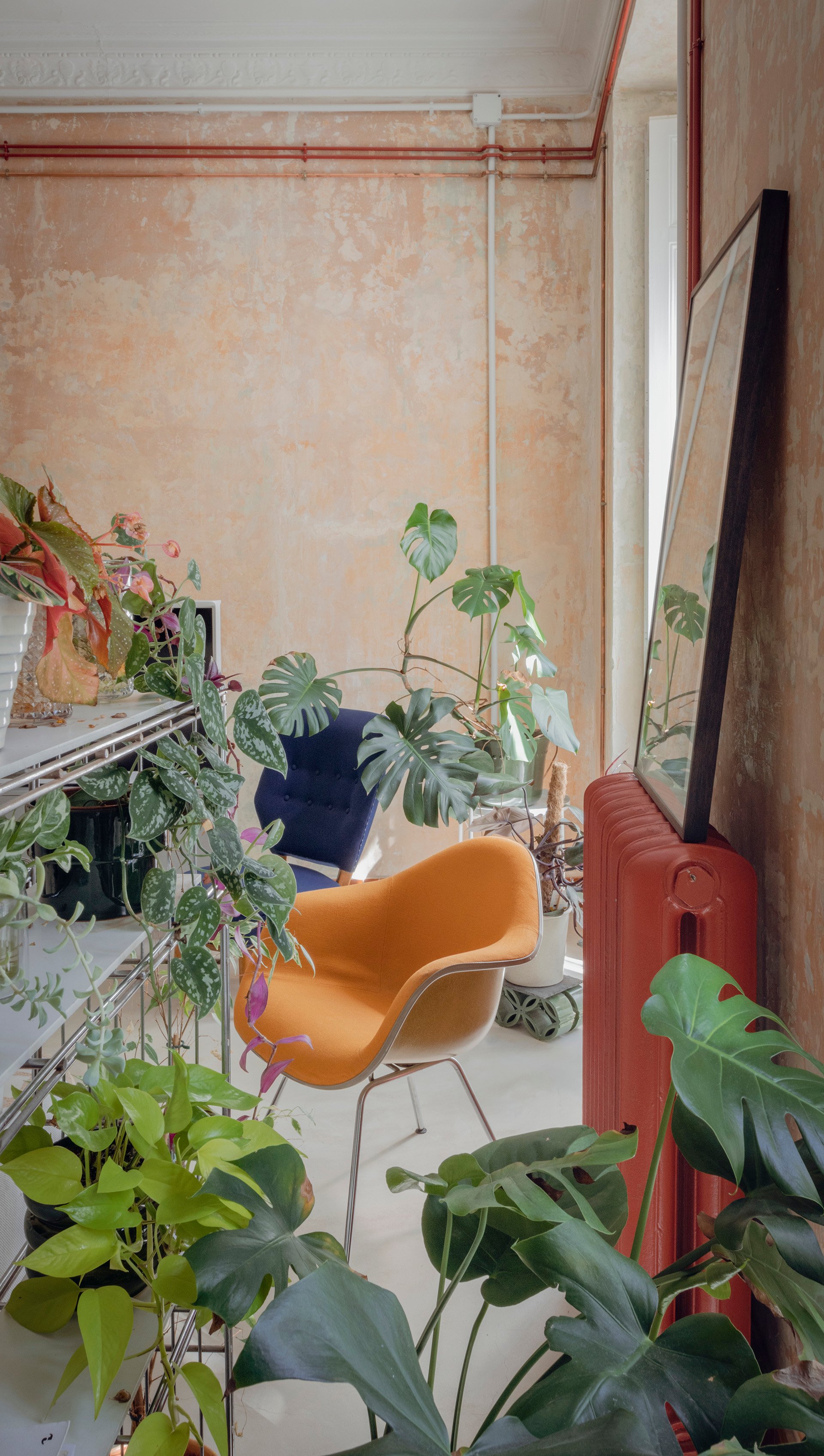
Materially, the entire space is presided over by a large red joinery system, inspired by many of the city’s traditional enclosures and the windows of Galerías Piquer. The project seeks to preserve as many original elements as possible, including moldings, doors, door glazing, handles, fittings and two radiators. The exposed brick party wall, the vertical supports of the load-bearing walls, and remnants of the home’s former paint layers are also recovered. This aesthetic is complemented by exposed installations: visible copper plumbing and braided cables for switches. Chromatically, each function is assigned a distinct tone, expressed through Seville crackle-glazed ceramic tiles. White ceramic for the bedroom with dark green radiators; dark green ceramic for the kitchen with green radiators; caramel ceramic with red radiators.
The result is an eclectic project, where industrial, Space Age and rustic elements coexist in a carefully balanced dialogue.
The renovation is located on Ribera de Curtidores Street, home every Sunday to one of the city’s most traditional plans: El Rastro flea market. History tells that the market takes its name from the traces once left by animal hides used by the tanners (curtidores) who were established along this street. The building is a historic construction from 1880, characterized by its three storeys plus attic, with the first floor higher than the rest. Built with load-bearing walls running parallel to both the main and rear façades, the renovation takes advantage of the three bays generated between them. These three bays are used to define the three key moments of domestic life. Opening up these spaces and carefully shaping their layout is where the project demands the greatest attention from the very beginning.
Eat, enjoy and love.
Eat: This is the central axis of the home, through which everyday life in the other two spaces subtly filters. A beer or a glass of wine can easily turn into a traditional cocido. Organized symmetrically around the island, the design deliberately avoids increasing the height of the cabinetry in order to preserve the presence of the original exposed brick party wall during meals. On the opposite side, a long white table helps bring light into the darkest area of the space. Enjoy: Life is meant to be enjoyed whether doing nothing on the sofa, working on what you are passionate about, or becoming the quintessential Rastro onlooker on Sunday mornings. The three balconies facing the living room are left completely open, without partitions, preserving original moldings, ceiling rosettes and radiators.
Love: The first thing in life , and upon arriving home , is to take care of oneself and to love as a couple. The bedroom is designed where the bed and the sink articulate circulation, with a lattice screen inspired by the natural world providing privacy for the shower area. The hallway is also used to introduce a guest toilet. Without a doubt, redefining this bay was the most complex part of the construction process.
Materially, the entire space is presided over by a large red joinery system, inspired by many of the city’s traditional enclosures and the windows of Galerías Piquer. The project seeks to preserve as many original elements as possible, including moldings, doors, door glazing, handles, fittings and two radiators. The exposed brick party wall, the vertical supports of the load-bearing walls, and remnants of the home’s former paint layers are also recovered. This aesthetic is complemented by exposed installations: visible copper plumbing and braided cables for switches. Chromatically, each function is assigned a distinct tone, expressed through Seville crackle-glazed ceramic tiles. White ceramic for the bedroom with dark green radiators; dark green ceramic for the kitchen with green radiators; caramel ceramic with red radiators.
The result is an eclectic project, where industrial, Space Age and rustic elements coexist in a carefully balanced dialogue.
Location: Ribera de Curtidores, Madrid Typology: Residential Client: Private Date: 2020-21 Photography: Alberto Amores Press: AD España; TeleMadrid; Diario Design