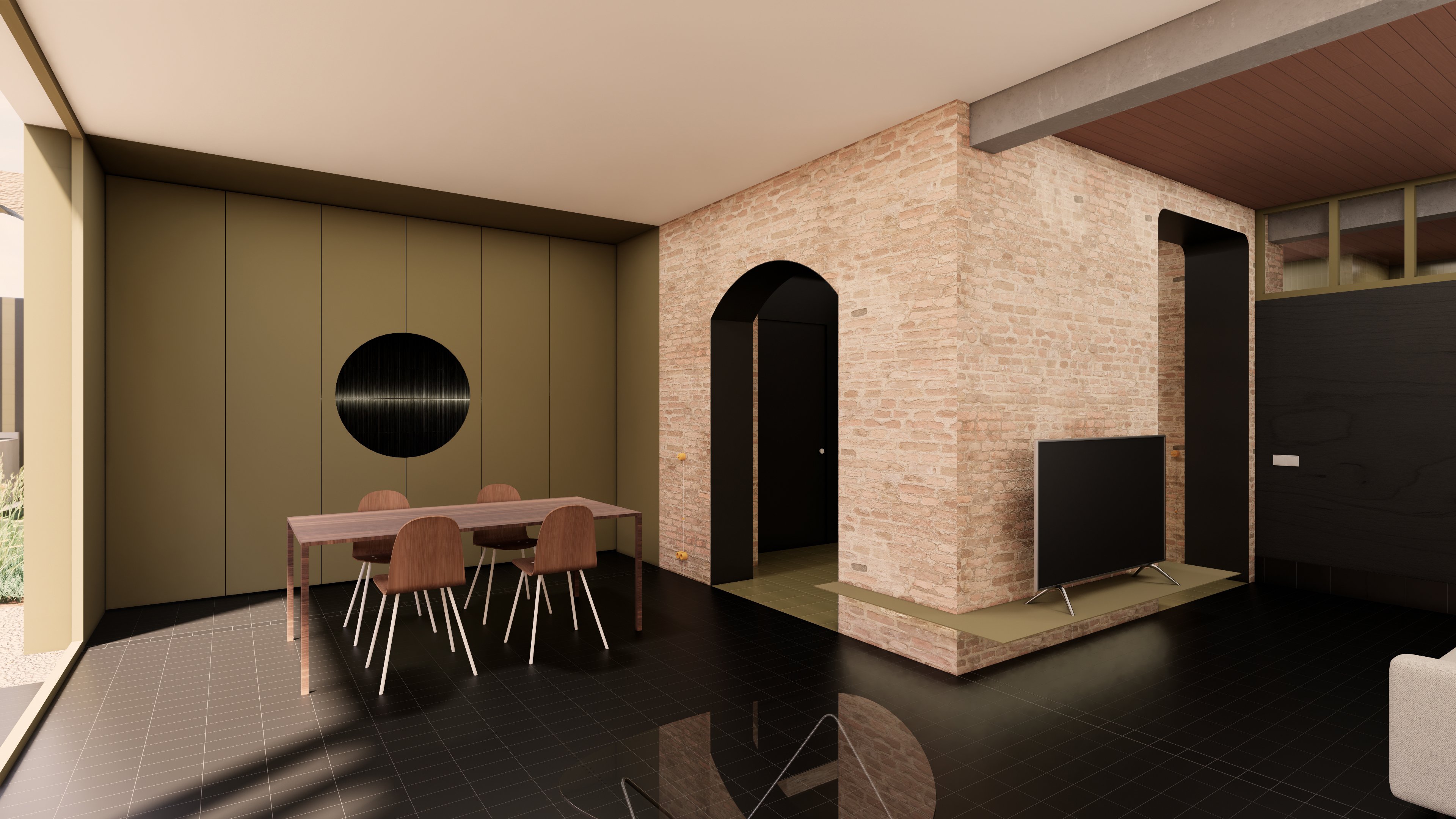
Location: Madrid Typology: Residential - Multi-use space Client: Private Date: 2025 Beetween Truses is a multi-purpose project located in Madrid, born from the client’s personal taste and the multiple references that emerged throughout an ongoing creative dialogue. The project draws its main inspirations from Spanish Modernism, Mid-Century architecture, and Castilian tradition. The intervention is set within a former industrial warehouse dating back to the 1930s, which was later complemented in the 1950s by the construction of a residential building for the heirs’ private use. Access to the warehouse was thus relegated to the commercial premises, leaving the industrial space concealed from street view and turning it into a hidden volume revealed through a gradual spatial sequence.
From the outset, the project sought to introduce flexibility into the front portion of the premises, allowing exclusive use of a defined area while enabling the remaining surface to be lent for film shoots or social gatherings. In this context, color and materiality become the primary devices structuring the space, delineating the boundary between private and public realms and accommodating multiple uses without relinquishing the identity of the place. The entrance operates as a threshold that must simultaneously resolve several accesses: from the street, from the residential building, to the client’s private bedroom, and to the cinematic area of the project. The bedroom’s location responds to the desired autonomy of this programmatic element in relation to the rest of the scheme. Fully connected to the exterior, it is the space where Castilian tradition becomes most evident, with the bed and bedside tables designed as brick masonry elements. The legacy of traditional latticework is reinterpreted to provide an Arabic-inspired intimacy that filters light and organizes the original façade. Additionally, a high-level window is introduced to enhance the perception of spatial depth and to allow cross ventilation when required.
In the living area, the design aims to reveal the building’s original construction materials while preserving the site’s inherent structural elements. A library and shelving area is integrated, allowing the client’s collection to act as a spatial prelude. The kitchen, integrated into the living space, is conceived as an open area that can also be concealed, reinforcing the flexibility of use not only within the room itself but throughout the entire project. By blurring the perception of the living–kitchen space, the project avoids being strictly categorized as a residential dwelling.
The patio is organized along the main visual axis that traverses the entire project, from the entrance through the living area, the access to the warehouse, and its far end becoming a hinge space between the industrial and the domestic. This dialogue is articulated through material continuity, recovering the original openings of the warehouse and introducing new apertures toward the living area that reveal a water surface and a small pool, elements that temper the microclimate and enrich the spatial experience.
Finally, the warehouse is conceived as the most versatile space within the project, devoid of a predefined program yet capable of accommodating a potential kitchen, bathroom, and mezzanine. The full depth of the space is utilized, reserving the rear section for these functions and lowering the floor level as permitted by the original foundations. The rhythm of the prefabricated concrete trusses is employed as a compositional tool to organize the layout and alternate access points, reinforcing the structural and spatial character of the intervention.
Between Truses is a multi-purpose project located in Madrid, born from the client’s personal taste and the multiple references that emerged throughout an ongoing creative dialogue. The project draws its main inspirations from Spanish Modernism, Mid-Century architecture, and Castilian tradition. The intervention is set within a former industrial warehouse dating back to the 1930s, which was later complemented in the 1950s by the construction of a residential building for the heirs’ private use. Access to the warehouse was thus relegated to the commercial premises, leaving the industrial space concealed from street view and turning it into a hidden volume revealed through a gradual spatial sequence.
From the outset, the project sought to introduce flexibility into the front portion of the premises, allowing exclusive use of a defined area while enabling the remaining surface to be lent for film shoots or social gatherings. In this context, color and materiality become the primary devices structuring the space, delineating the boundary between private and public realms and accommodating multiple uses without relinquishing the identity of the place. The entrance operates as a threshold that must simultaneously resolve several accesses: from the street, from the residential building, to the client’s private bedroom, and to the cinematic area of the project. The bedroom’s location responds to the desired autonomy of this programmatic element in relation to the rest of the scheme. Fully connected to the exterior, it is the space where Castilian tradition becomes most evident, with the bed and bedside tables designed as brick masonry elements. The legacy of traditional latticework is reinterpreted to provide an Arabic-inspired intimacy that filters light and organizes the original façade. Additionally, a high-level window is introduced to enhance the perception of spatial depth and to allow cross ventilation when required.
In the living area, the design aims to reveal the building’s original construction materials while preserving the site’s inherent structural elements. A library and shelving area is integrated, allowing the client’s collection to act as a spatial prelude. The kitchen, integrated into the living space, is conceived as an open area that can also be concealed, reinforcing the flexibility of use not only within the room itself but throughout the entire project. By blurring the perception of the living–kitchen space, the project avoids being strictly categorized as a residential dwelling.
The patio is organized along the main visual axis that traverses the entire project, from the entrance through the living area, the access to the warehouse, and its far end becoming a hinge space between the industrial and the domestic. This dialogue is articulated through material continuity, recovering the original openings of the warehouse and introducing new apertures toward the living area that reveal a water surface and a small pool, elements that temper the microclimate and enrich the spatial experience.
Finally, the warehouse is conceived as the most versatile space within the project, devoid of a predefined program yet capable of accommodating a potential kitchen, bathroom, and mezzanine. The full depth of the space is utilized, reserving the rear section for these functions and lowering the floor level as permitted by the original foundations. The rhythm of the prefabricated concrete trusses is employed as a compositional tool to organize the layout and alternate access points, reinforcing the structural and spatial character of the intervention.
Location: Madrid Typology: Residential / Multi-use space Client: Private Date:2025